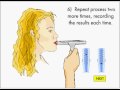
* How to use a peak flow meter ? * Why should you repeat the test more than one time ? * Which is the right result the highest or the intermediate result ?
#Mucolytic agent in Bronchial disorders, chronic bronchitis, asthma, emphysema, pulmonary complications of surgery.
# Antidote for acetaminophen poisoning.
Mechanism of action
# As mucolytic agent: disrupts disulfide bonds in mucoproteins thereby lowering viscosity of mucus.
# As antidote for acetaminophen poisoning: complexes with hepatotoxic free radial metabolite of acetaminophen and inactivates it.
route / Dosage form
# Route : Oral, inhalation, IV.
# Dosage form : Soln: 10, 20%
Dose
# Bronchial disorders, chronic bronchitis, asthma, emphysema, pulmonary complications of surgery :-
* Adults: 6–10 mL of 10% solution, q2–3 hours by nebulizer.
* Children: 3–5 mL of 10% solution, q2–3 hours by nebulizer.
* Infants: 2–4 mL of 10% solution, t.i.d. to q.i.d., IV.
* Alternate: 20% solution may be given in half of above volumes.
# Antidote for acetaminophen poisoning
* Adults, children: Initially 140 mg/kg, then 70 mg/kg q4h orally x 17 doses. All 17 doses must be given, even if acetaminophen levels have declined to non-toxic range. If patient has emesis with 1 hour of dose, repeat dose immediately.
Pregnancy / Lactation
# Pregnancy: Category B.
# Lactation: No data available. Best to avoid.
Adverse reactions
# Common: vomiting, olfactory disturbance.
# Serious: bronchospasm (especially in asthmatics), hypotension.
Important interactions
# None
Contraindications / precautions
# As inhaled drug: may induce bronchospasm. If this occurs, administer bronchodilator; suction bronchial secretions if they develop after inhalation.
# Elderly: May have reduced cough reflex and therefore reduced ability to clear airway of liquefied mucus. May need concomitant suction.
# For patient with asthma or hyperactive airway disease, a bronchodilator should be administered before acetylcysteine.
Other notes
# To be given before meals and just before bedtime for asthma.
# As antidote for acetaminophen poisoning: Administer as quickly as possible. Most useful if given within 12 hours of ingestion of acetaminophen.
Practical notes
#Rinse mouth out and wash face after treatment to remove adhering drug.
Generic names
# Egypt :- Acetylcistein , ACC , Mucomyst .
# KSA :- ------
# prepared by : Dr.Mohamed Abd Elrahman
# References:- Handbook of clinical drug data, 10th edition. - Clinician's handbook of prescription drugs . - Physicians' Drug Manual 2005 Edition . - Egyptian drug index . - Saudi drug index .
* What is asthma and what are its causes ? * Where are the following in the respiratory system : trachea, bronchi, broncheols, alveoli, cilia, mucus ? * What is the role mast cells and histamine in occurring of asthma and what is the effect of epinephrine on them ?